Blending Fact with Fiction – FMP

Following on from my research of the people who lived in my house and my visit to Dennis Severs I have started to create fictional people who could have lived in my house after 1911, when the census is no longer available. I decided to create people for the years 1931, 51 and 71 as I think this will give a good overview of the life of the house. I will use the history of the area to help create and support a narrative, elaborating on the people I already know of, giving them some sort of personality and interests, turning them into people rather than just statistics and developing whole knew people for the later years.

1931 – In pre World War Two times there was a big fascist movement in Britain, and in Newham, with West Ham having its own district fascist group, using this information I have decided to have a fascist man living in the house at this time along with his mother and a boarder, which a lot of the previous families had. The boarder will be a factory worker at the Tate and Lyle sugar factory in Plaistow which was a massive employer for the area.

http://www.e7-nowandthen.org/2014/04/fascists-in-1930s-forest-gate.html 

1951 – In 1951 the Forest Gate Maternity Hospital had just recently opened so the occupants of the house will be a doctor who had moved to work at the hospital, along with his family. Most women did not work after they were married so his wife would have been a “housewife”.

https://discovery.nationalarchives.gov.uk/details/r/f7c310f2-8214-45d6-94e8-be0f2ba1bdca

1971 – In the 70s a lot of asian and black people moved into London and with this came a lot of racism. It was also a time when married women were more able to have jobs and independence.

Dennis Severs House – FMP

I went to visit Dennis Severs House, a terrace house in Spitalfields in which the ten rooms have been recreated as a still life drama and a historical imagination of the years 1724-1914. Dennis severs lived in the house from 1979 to 1999 crating the journey the house takes you on. The candle and gas lighting, the background sounds and scents drifting through and the make the imposed silence make the experience very immersive, as if you are walking through a piece of art, cautious not to disrupt anything. The most fascinating thing about the house is that it appears as if the occupants were just in the rooms, playing card games, having tea or lying in bed. Each room tells a different part of the story of the family of Huguenot silk weavers named Jervis.

Having a narrative go along with the house made it a lot more personal and meaningful, the rooms weren’t just rooms but they were someones home with someones things in. in life most domestic spaces have stories to go along with them but you probably only know your part of it.


The Bedside Table – FMP

I will never deny that I am a messy person and a lot of my mess tends to accumulate on my bedside table. Taking the mess out of the room and putting it in a neutral background allows you to focus on each object and its place on the table. For me everything on the table has a story and reason behind it and how it got there, but to anyone else it is probably just rubbish.

This led me on to thinking about how every piece of furniture, scuff or bit of tat in our homes has a reason behind it getting there, sentimental or practical. If you want it to a room can tell a story, just like a painting or a sculpture, and in some cases it can be much more personal.

Domestic spaces – FMP

Jeremy Deller

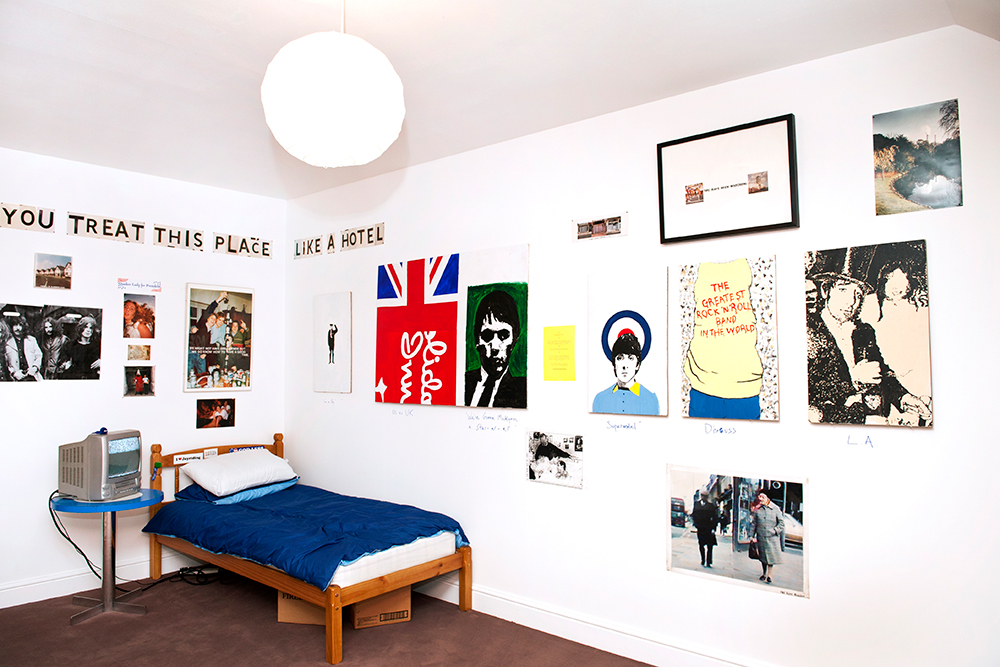
In 1993 Jeremy Deller staged an exhibition in his parents house while they went on holiday, calling it “Open Bedroom”. he replaced work his parents had bought with his own and invited people to view it.


As part of his retrospective he recreated from 1993 his bedroom with the pieces of work. I think there is something interesting about seeing inside somebodies home, particularly the bedroom as its a very personal space. In this case you can see familiar aspects of a teenage/young adults bedroom but it also reminisces back to Deller’s unconventional and spontaneous exhibition.

Photography: Courtesy of Jeremy Deller (c)

Tracey Emin

There are a lot of aspects of Tracey Emins my bed I enjoy, it is extremely personal and gives you an insight into her mind at the time, the bed looks as if someone has just left it, a scene of chaos in a pristine white room. I think people like it because it feels very familiar.


Image result for tracey emin


Exploring the home – FMP

I am starting this project by looking into the history of my own home, I want to see the different types of people who have lived there, how they has changed over time and what this can tell me about East London. I live in a very typical victorian terrace house on a street of identical houses.

DSC02480.JPG

I began researching and found a selection of people who had lived in my house on the census, however they are only available up until 1911. Finding out what jobs the people had can tell me a lot about their class.

I found it interesting to learn that in 1881 the family living in my house had a servant suggesting they were quite well off, this would definitely have been reflected in their decor. They would have been the first people to live in the house so it would have been in perfect condition and potentially could have been seen as quite modern at the time.

People often use their homes to show off their wealth, although people are still house proud nowadays there is less pressure to maintain a spotless or formal home, this is probably to do with how women roles have changed, none of the women listed on the census had jobs instead they would have been housewives, their home was part of their reputation.

I want to explore domestic spaces, these spaces are places we spend a lot of our time and often are filled with things reflect our identities and the time we live in. the rooms within my house will have dramatically changed throughout its time.

FMP Proposal

UNIT 4 Project Proposal 


Centre name Ravensbourne University Centre no. 14271
Student name Freya Chauncy Candidate no. 6140207958
Project title A London Home
Date 25/02/19
Pathway 3DCP (3D and Contemporary Practice)
Section 1: Rationale (approx. 150 words)
The foundation course so far has been a very valuable experience, it has supported me to develop my artistic practice as well as helping me to develop a deeper contextual understanding. The Diagnostic stage allowed me to experiment with different creative forms, such as photography and textiles, and helped me to decide what I wanted to pursue. It also gave me valuable skills to take through to the Developmental stage. Choosing 3DCP has helped me develop my conceptual thinking and research skills, It has taught me to become more observant of things around me giving my pieces deeper meanings. I have enjoyed using different formats and materials for example creating my ‘Pink Rebirth Cake’ as this was an unconventional medium and something I found exciting. I also liked the process of creating work quickly in timed periods, from sculptural pieces to drawings as this helps stimulates different ideas. I will take these ideas and processes through with me to the consolidation stage and hopefully onto a degree in fine art.
Section 2: Project concept (approx. 250 words)
The history of London and the different people that have lived here has always interested me particularly as the city has changed so much just in my lifetime. Exploring this in a more personal way is something that appealed me so I plan to research the history of my home where I have lived since I was born. This is a victorian terrace house typical of many streets in London.  I intend to research the different people that have lived here since it was built in 1878. I aim to not just look at how the house and furnishings have changed but how the class, occupations and ethnicity of the people have changed and what that can tell me about East London. I would like to experiment with showing my ideas through sculpture, photography, and printmaking. The artists I am going to research to influence my project are Rachel Whiteread (Fig. 1), Joseph Cornell (Fig. 2) and Leandro Erlich (Fig. 3) among others. I find Rachel Whiteread’s casting of a house in Bow before it’s demolition particularly interesting, not only is the actual sculpture striking but it also is a monument to those who lived on Grove Road and a comment on the regeneration of the East London. I will also be using the Census to research context and historical knowledge relating to my project. I hope to be able to present my work in an engaging and informative format.
Section 3: Evaluation (approx. 100 words)
Evaluation is a very important part of any project particularly for helping to develop and progress work, this will be important as this is the longest project so far. I will continue to use my blog for written reflection and recording my work and process. Crits and Tutorials with teachers and my peers will also be a valuable form of evaluation, getting other people’s opinions on my work is something I find very useful as it allows me to get a new perspective. Experimenting and using trial and error is something I will do to develop new ideas and decide what works best. I will write a final statement which I can use to compare my whole project to my initial proposal.
Proposed research sources and bibliography (Harvard format)

online

visits

  • Dennis Severs house
  • Museum of London
  • William Morris Gallery
  • Don McCullin – Tate Britain
  • Childhood museum

films

  • It Always rains on sunday, 1947, Robert Hammer

books

  • Berger, J. 1972. Ways of Seeing. 1st ed. United Kingdom: Penguin.
  • Deller, J. 2012. Joy In People. 1st ed. London: Hayward

Appendix

Doreen fletcher, East End Dentist, 2017

Image result for Doreen fletcher, East End Dentist, 2017

Elmgreen and Dragset, The Whitechapel Pool, 2018

Image result for Elmgreen and Dragset, The Whitechapel Pool, 2018
Do Ho Suh, Home Within Home, 2013
Image result for Do Ho Suh, Home Within Home, 2013

Alice Pasquini, The Unchanging World, 2017

Image result for Alice Pasquini, The Unchanging World, 2017

(Fig. 1) Rachel whiteread, house, 1993Image result for Rachel whiteread, house, 1993


(Fig. 2) Joseph Cornell, Homage to Juan Gris, 1953–54

Image result for (Fig. 2) Joseph Cornell, Homage to Juan Gris, 1953–54

(Fig.3) Leandro Erlich, Dalston House, 2013

Image result for Leandro Erlich, Dalston House, 2013

Jeremy Deller, Open Bedroom, 1988-1994
Image result for Leandro Erlich, Dalston House, 2013

Tracey Emin, My Bed, 1998

Image result for Tracey Emin, My Bed, 1998


Project action plan and timetable
Week Date week

beginning

Activity/what you intend to do – including independent study Resources/what you will need to do – including access to resources
1 4th of March Initial research through both primary and secondary sources, record through blog posts, photography and sketchbook. sketchbook, https://www.ons.gov.uk/census, library, Dennis Severs’ House, critical reading
2 11th of March Further and more specific research, begin thinking about materials/techniques. record on blog and in sketchbook galleries, sketchbook, critical readings,notes, visit Tracey Emin at Whitecube gallery  
3 18th of March Develop initial ideas, experiment with different processes and formats materials, sketchbook, online research, exhibitions
4 15th of April Further experimentation, evaluate what was successful and what wasn’t materials, sketchbook, camera
5 22nd of April Begin constructing final piece, record process on blog and sketchbook materials,camera
6 29th of April Continue constructing final piece, record process on blog and sketchbook materials,camera
7 6th of May Finish constructing final piece, record process on blog and sketchbook materials,camera
8 13th of May Refine final piece, record and evaluate on blog and in sketchbook, prepare exhibition space and how piece will be presented materials,camera


Evaluation of Photo Album

Overall I am really pleased with how my photo album turned out, I enjoyed the process of taking pictures on a film camera and not knowing what was going to come out, or if I would end up with any photos at all. I also liked making the book myself, it was something I could hold in my hand and very much less disposable than a photo album on your phone.

I would like to continue taking photos on film sporadically over a year and then create an album at the end, to have a random selection of events, places and people I have come  in contact with.

Human Behaviour and Idea Development

When thinking about the body it lead me on to the idea of human behaviour, most people are fascinated by what other people do, this is probably why we love reality tv shows, celebrities and social media.

I really like the idea of documenting things and making a photo album, mainly because we never have photo albums anymore and everything is done digitally. I also want to use a film camera as this makes the pictures less disposable, you think more about the picture your taking. I want my photo album to have a comedic element, as I’m going on holiday to Benidorm, a typical British holiday and big ex-pat area I think this would be good opportunity to take some photos.

I was really inspired by Martin Parr in my ideas, I really like his bright photography and the comedic, unrealistic style of his photography.

Image result for martin parr

Image result for martin parr

I am also inspired by the photographer Richard Billingham, I really like his raw style of photography and the way its very personal to him.

Image result for richard billingham

Image result for richard billingham


The Body Project

Starting/stimulating questions

How do you feel about your body? I feel confident and comfortable in my own body, I wish I was stronger or fitter but I know that is something I can change

Are you aware of your physicality, your being? I am aware of my physical habits and the way I move especially when other people also notice them, I become much more aware of my physicality when men look at me or comment on me.

What are you thinking? I am thinking about what my body should be doing until I start thinking of something else and my body does it without thinking too much

How do you express this? Through movement and speech

Are you aware of your conscious self, your unconscious self? I am comfortable with my conscious self, I know who I am, when I am unconscious I am unaware, Im not sure of the way I move or what I do

How do you see others? I think I judge on appearance too quickly and without reason

Do you watch human behaviour? I find human behaviour really interesting I like to be able to work people out and to know what they are going to do and how they will act

Are you aware of personal space? I am aware of personal space but it changes for different people, people who I am closer with I am more touchy with them.

Do you appreciate the body? I appreciate the body, how it moves and the form

How do you make value judgements on others? before I form a final opinion wait to get to know them see what their personality is like

Do you see weight, hair, eyes, skin, Male, Female? I see them because I think we are programmed to but I don’t judge on them

Doreen Fletcher – A Retrospective

Recently I went to see an exhibition of Doreen fletchers work at the Nunnery gallery in Bow, it was a series of paintings from throughout her life. The paintings are all of east London current and past. I loved how they were not of stereotypical or pretty settings people would normally paint, this gave them character and were a lot more approachable, particularly as they are of the local area.

Image result for doreen fletcher  Image result for doreen fletcher

Image result for doreen fletcher

Create your own website, free on WordPress.com.Create your own website.
Start free